
Art Authentication Guide for Buyers
A work can look right, feel right, and still fail the market. That is the central fact behind any fine art authentication guide worth reading. In the upper tier of the art trade, authenticity is not a matter of taste. It is a matter of proof. One mistake can cost millions, stall an estate settlement, derail a sale, or turn a valuable object into a ghost asset that cannot be financed, insured, or resold with confidence.
For serious collectors, investors, and fiduciaries, authentication is not a ceremonial step taken after purchase. It is a risk-control process. The right question is not simply, "Is this genuine?" The better question is, "Can this work withstand scrutiny from auction specialists, buyers' counsel, insurers, and scholars?"
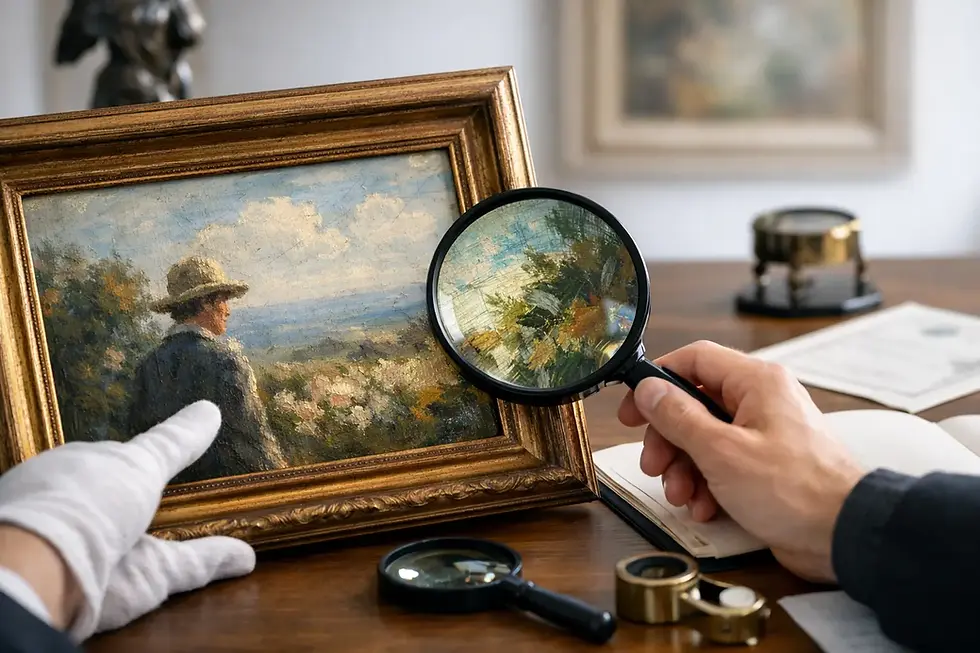
What a fine art authentication guide should actually address
Most discussions of authentication oversimplify the problem. They imply that a single expert opinion, a signature, or a family story can resolve authorship. That is not how high-value transactions work. Authentication is cumulative. It relies on converging evidence, and each category of evidence has strengths, limits, and market implications.
A credible review usually considers provenance, catalogue raisonné status, stylistic comparison, physical condition, materials analysis, imaging results, and the position of relevant scholars or artist estates. None of these elements should be treated in isolation. Provenance can be fabricated. Scientific testing can eliminate possibilities without conclusively naming the artist. An expert opinion may carry weight, but weight is not finality.
The market rewards defensible attribution, not optimism. That distinction matters most when a work is being prepared for acquisition, consignment, division of assets, donation, or litigation.
The evidence chain behind defensible authentication
Authentication begins with documentation, but documentation alone is rarely enough. Provenance is often the first point of review because it establishes whether ownership history is coherent, continuous, and plausible. A gap does not automatically disqualify a work. Many legitimate objects have incomplete records. But a gap changes the burden. It requires stronger support elsewhere.
A disciplined provenance review checks dates, locations, owners, exhibitions, invoices, labels, customs paperwork, and archival references for consistency. If a painting is said to have been in Europe in one year and appears in a US gallery stock book during that same period, the issue is not minor. Contradictions of that kind weaken the entire file.
Catalogue raisonné review is the next major threshold. Inclusion can materially strengthen market confidence. Exclusion, however, does not always mean the work is false. Some catalogues remain incomplete, disputed, or closed to new submissions. Still, if a recognized authority has formally rejected a work, that fact will affect liquidity even if other evidence remains supportive.
Stylistic analysis has a role, but it must be handled carefully. A painting may resemble the hand of a known artist while still being a studio work, later copy, follower piece, or deliberate fake. Close comparison of composition, brushwork, underdrawing, scale habits, recurring motifs, and period-specific execution can identify alignment or inconsistency. Yet style is persuasive only when supported by material and documentary evidence.
Scientific examination is not optional at the high end
When stakes are significant, technical analysis is not a luxury. It is part of the standard of care. Scientific examination can identify anachronistic pigments, modern binders, inconsistent supports, concealed restorations, transferred signatures, and later interventions that alter attribution risk.
Ultraviolet and infrared imaging often reveal what the eye cannot. UV may expose overpainting, varnish irregularities, and retouching patterns. Infrared can show underdrawing, pentimenti, or changes in composition that may align with an artist's known working process. High-resolution imaging can isolate craquelure behavior, tool marks, and surface disturbances that deserve closer review.
Pigment analysis is especially useful when a work is attributed to a period before certain materials were commercially available. Carbon dating may help with organic supports, though results must be interpreted narrowly. It can date a material range, not certify authorship. That is a recurring problem in this field. Clients often want a single test to provide a final answer. No serious examiner should promise that.
AI-assisted comparative analysis can add another layer, particularly when measuring visual correlations across a large body of reference material. But AI is not an authority. It is an analytical aid. It can detect patterns, flag anomalies, and strengthen comparative review, yet the conclusion must still rest on expert interpretation and evidentiary balance.
Why expert opinions vary
Clients are often surprised when one specialist is supportive and another is cautious. That does not always mean one is wrong. It may mean they are working from different standards, different reference sets, or different tolerance for unresolved risk.
Some experts are willing to offer an informal view from photographs. Others will not comment without physical inspection, technical testing, and provenance review. Some artist foundations have become reluctant to authenticate at all because of legal exposure. In those cases, the market may rely on indirect evidence and the judgment of senior scholars, auction-house specialists, and independent forensic reviewers.
This is where many transactions go wrong. Buyers mistake a positive conversation for a defensible conclusion. Sellers assume confidence is transferable. It is not. The closer a work gets to public sale, institutional scrutiny, or legal challenge, the more informal assurances lose value.
A practical sequence before you buy or sell
A serious buyer should begin before funds move. First, establish what is being claimed. Is the work attributed to the artist, from the studio, from the circle, or after the artist? These are not interchangeable categories. Price, insurability, and resale options depend on the exact language of attribution.
Next, request the full documentation file, not a curated excerpt. Review invoices, prior appraisals, conservation reports, shipping records, exhibition history, labels, certificates, and any prior expert correspondence. A clean-looking PDF packet can still conceal major gaps.
Then assess whether the claimed authorship is market-usable. A work may be genuine in a broad sense yet still difficult to sell if it lacks catalogue recognition, has unresolved provenance, or carries prior rejection history. Value is not declared - it is proven in the marketplace through evidence that others will accept.
At that point, technical review should be calibrated to the risk level. A six-figure purchase may justify one level of analysis. A seven- or eight-figure acquisition justifies much more. The same logic applies before sale. If a work is heading toward an auction house known for rigorous vetting, unresolved issues should be addressed in advance, not after consignment discussions begin.
The difference between authenticity and market acceptability
This distinction is uncomfortable but essential. A work can be authentic and still commercially impaired. If documentation is thin, if foundation support is absent, or if prior restoration has obscured critical evidence, the market may discount or avoid the work altogether.
That is why authentication should be treated as a liquidity issue, not just an academic one. Collectors often focus on whether they personally believe in a piece. The market asks a harsher question: will the next buyer, lender, insurer, or institution accept the evidence? If the answer is uncertain, the asset may remain effectively trapped.
Independent assessment matters here because transaction participants often have incentives that are not fully aligned with yours. A seller wants certainty. An intermediary wants momentum. Even a respected specialist may be influenced by incomplete access or institutional constraints. The buyer, estate, or trustee needs evidence that can survive outside the transaction itself.
When to walk away
Not every uncertainty is fatal. Gaps can be explained. Records can be recovered. Testing can strengthen a case. But some warning signs deserve immediate caution.
A work with contradictory provenance, unusual urgency from the seller, resistance to scientific examination, vague attribution language, or reliance on unsigned certificates should be treated carefully. The same applies when value seems radically misaligned with category, condition, or documentation. Bargains exist, but major discounts often price in hidden risk.
The right decision is sometimes restraint. Walking away from an uncertain object is not a missed opportunity if the evidence cannot support future market confidence. Discipline preserves capital more effectively than hope.
Fine art authentication guide for high-stakes decisions
For sophisticated market participants, the standard is clear. Authentication is not a single opinion and not a decorative appendix to a sale. It is a structured evidentiary process designed to protect value, reduce exposure, and support marketability under scrutiny.
That process works best when it is independent, technically informed, and explicit about uncertainty. Strong cases are built through converging proof. Weak cases often rely on reputation, intuition, or selective paperwork. The market eventually separates the two.
VWART approaches authentication from that stricter position because serious transactions require more than reassurance. They require a conclusion that can be defended when the stakes are real.
If a work matters financially, legally, or reputationally, treat proof as part of the asset itself. When the evidence is strong, confidence follows. When it is not, the smartest move is to know that before the market tells you the hard way.


Comments