
Estate Art Appraisal Services That Hold Up
An estate can hold millions in art and still face a simple problem: nobody can prove what is there, what it is worth, or whether the works will survive scrutiny. Estate art appraisal services exist for that exact pressure point. They are not administrative formalities. They are risk controls for assets that may be sold, divided, donated, insured, taxed, or challenged.
That distinction matters because estate situations compress time, emotion, and financial exposure into a single file. Heirs may disagree. Executors may need fast answers. A tax filing may require a supportable date-of-death value. A planned consignment may depend on whether an attribution is market-accepted or vulnerable. One weak assumption can distort an entire estate strategy.
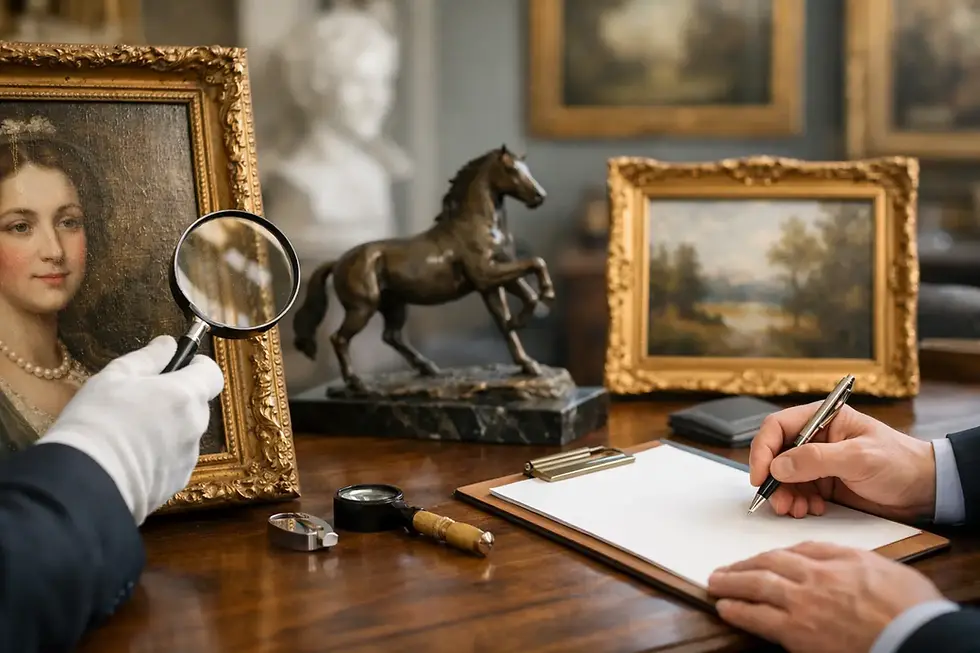
What estate art appraisal services actually do
At a serious level, estate art appraisal services establish a defensible basis for decision-making. That usually means identifying the artwork correctly, assessing authorship and attribution risk, documenting condition, reviewing provenance, and arriving at a valuation standard that fits the purpose. The purpose is never a minor detail. An appraisal for equitable distribution is not identical to one prepared for an IRS matter, insurance scheduling, charitable donation, or pre-sale planning.
Too many estates begin with a casual estimate, a family belief, or a number pulled from an old insurance schedule. None of those is enough when the work is high value, poorly documented, or likely to attract scrutiny from auction specialists, tax authorities, opposing counsel, or skeptical beneficiaries.
A credible appraisal is not a guess with polished language. It is a documented conclusion built on evidence. If the art is significant, valuation and authentication cannot be separated cleanly. Market value depends on what can be proven. A work with an uncertain attribution may look visually convincing and still trade at a fraction of what the family expects. In the upper market, value is not declared - it is proven.
Why estate cases are different from standard appraisals
Estate matters are unusually exposed because they involve more than price. They involve accountability. The executor has fiduciary duties. Advisors need records that can withstand review. Beneficiaries may challenge distributions years later. A sale that underperforms can trigger questions about whether the collection was properly examined in the first place.
The core issue is that estates often contain documentation gaps. Works may have been acquired decades ago from dealers who no longer exist. Labels may be missing. Provenance may be oral rather than written. Prior appraisals may rely on outdated market assumptions or weak attributions. Even genuine works can become functionally illiquid when the paperwork is thin. They turn into ghost assets - objects with apparent value but limited market usability.
That is why serious estate appraisal work often extends beyond valuation into forensic review. If a painting is attributed to a major artist but cannot satisfy current market expectations, the estate has a problem that no optimistic number will solve.
When appraisal alone is not enough
This is the point many estates miss. They ask for value before confirming market acceptability. That sequence can be costly.
If a work is by a blue-chip or frequently forged artist, the market may demand stronger support than visual opinion. Provenance analysis, comparative study, technical imaging, pigment review, archive checks, catalogue raisonné status, and specialist consultation may all become relevant. The exact depth depends on the object, the artist, and the intended use.
There is no single rule. A decorative regional painting with complete paperwork does not require the same scrutiny as a disputed modernist canvas expected to produce a seven-figure result. But in both cases, the estate needs to know where uncertainty sits. Precision matters. So does restraint. Overstating confidence is as dangerous as understating value.
Authentication risk changes the valuation outcome
An appraisal that ignores attribution risk can mislead the estate from the start. Consider three common scenarios. A work may be accepted as authentic and readily marketable. It may be likely authentic but burdened by insufficient documentation, which limits liquidity and price. Or it may carry unresolved doubts that make a major-market sale unrealistic.
Those are not semantic differences. They produce radically different outcomes in tax planning, division among heirs, insurance, and sale strategy. A defensible appraisal must reflect the market reality attached to the object as it exists, not the value the estate hopes to realize under ideal circumstances.
What a serious appraisal process should include
For higher-value estate property, the process should begin with exact identification and purpose definition. The appraiser needs to know whether the report is for estate tax, sale, insurance, collateral analysis, charitable planning, or dispute support. The valuation date must be clear. The legal owner or fiduciary authority must be clear as well.
From there, competent work moves through object examination, documentation review, market comparison, and condition assessment. If red flags appear, deeper forensic or art historical investigation should follow before final value conclusions are fixed. In sophisticated estate matters, this may involve high-resolution image analysis, ultraviolet and infrared examination, material analysis, provenance reconstruction, and comparison with accepted works.
The reporting standard matters just as much as the investigation. A serious report states what was examined, what evidence was available, what assumptions were necessary, what uncertainties remain, and how the valuation conclusion was reached. That kind of reporting protects the estate because it shows method, not just outcome.
Red flags that call for elevated scrutiny
Not every estate artwork demands technical testing, but some indicators should stop the process immediately. A major name with no paper trail is one. A work that has changed attribution over time is another. Foundation rejection, conflicting labels, suspicious signatures, undocumented restorations, and values wildly out of line with prior records also justify caution.
Cross-border estates add another layer. A work acquired in Europe, stored in the US, and intended for sale through a global auction house may encounter inconsistent documentation standards, export history questions, and title complications. Those issues belong inside the appraisal discussion, not outside it.
Choosing estate art appraisal services without buying false confidence
The market is full of polite opinions. Estates dealing with meaningful art need more than that.
A capable provider should understand valuation standards and the fine art market at transaction level, not just textbook level. They should know when a condition issue is cosmetic and when it destroys buyer confidence. They should know how auction houses, specialists, and private buyers react to incomplete provenance. Most of all, they should be willing to say that a valuation question cannot be answered responsibly until an authorship question is addressed.
That discipline is not obstruction. It is protection.
The right service provider is also independent. An estate should be wary of advice shaped by a hidden sales agenda. If the same party is eager to secure consignment, downplay uncertainty, and promise a result before the file is examined, caution is warranted. The estate needs clarity, not inducement.
At the upper end of the market, some firms approach appraisal the way expert witnesses approach evidence. That standard is closer to what estates actually need when value is material and scrutiny is likely. VWART operates in that space, combining appraisal judgment with forensic authentication discipline for cases where weak documentation or attribution risk could compromise marketability.
The cost of getting it wrong
One mistake can cost millions. But the more common damage is slower and less visible.
An overstated appraisal can trigger tax exposure, litigation friction, and failed sale expectations. An understated one can shortchange beneficiaries and distort estate distribution. A poorly supported attribution can leave an executor defending a number that no serious buyer accepts. Once a questionable work is publicly offered and rejected, reputational damage follows the asset.
There is also a timing problem. Estates often postpone hard questions to keep administration moving. That feels efficient until a planned sale stalls, a beneficiary disputes value, or a tax advisor asks for support that does not exist. By then, the estate is solving the same problem under more pressure and with fewer options.
Estate art appraisal services as a strategic function
The strongest estates do not treat appraisal as paperwork. They treat it as a sequencing tool.
First establish what the object is, how securely it can be attributed, how the market is likely to view it, and what evidence supports that position. Then decide whether to hold, sell, donate, insure, divide, or litigate. That order reduces errors because strategy follows proof.
It also creates leverage. When documentation is strong and methodology is clear, the estate can move with confidence in front of auction houses, insurers, tax counsel, and beneficiaries. When the file is weak, the estate at least knows the weakness before the market exposes it.
That is the real purpose of serious estate art appraisal services. They do not simply assign numbers. They convert uncertainty into a documented position the estate can act on.
If an artwork in an estate may matter financially, legally, or reputationally, the right question is not What do we think it is worth? The right question is What can we prove, and will that proof hold when it matters most?


Comments