
How to Sell Undocumented Art without Ruining Value?
A painting with no paperwork is not merely inconvenient. In the upper art market, it is a liability. If you want to know how to sell undocumented art, the first fact to accept is blunt: the object may be visually compelling, even genuine, and still remain commercially impaired. Value is not declared - it is proven.
That distinction matters because undocumented art does not fail in one single way. Some works lack full provenance but retain a plausible attribution. Others have family history but no purchase records. Some have labels, inscriptions, or exhibition traces that were never assembled into a coherent evidentiary file. And some are simply unsupported objects carrying a hopeful name. The route to sale depends on which problem you actually have.
Serious buyers, estates, institutions, and auction specialists do not buy confidence from storytelling. They buy confidence from documentation, technical consistency, and market defensibility. If the work cannot withstand scrutiny, the sales process will collapse late, publicly, and at the worst possible moment.
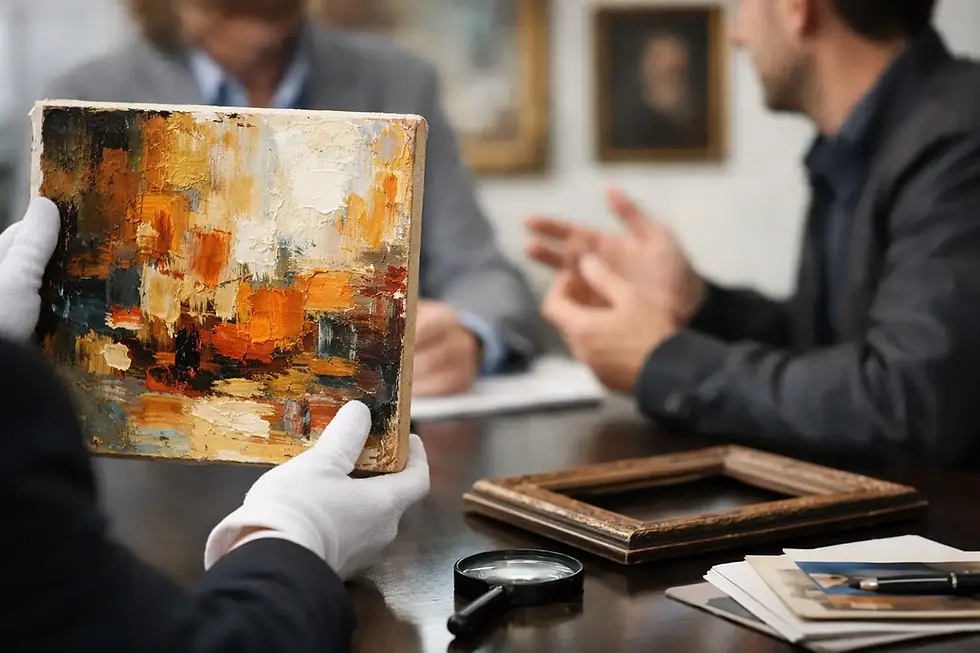
How to sell undocumented art starts with diagnosis
The first mistake sellers make is going straight to listing. They assume the market will "decide" and that a strong image, an inherited family account, or an old frame will do enough work. That is rarely true at meaningful price levels.
Before considering any channel, establish what is missing. Is the issue authorship, provenance, date, medium, condition, legal title, or all of them? An undocumented work may be sellable at a modest level with clear disclosure, but a high-value work requires a far more disciplined file. If the attribution is ambitious and the evidence is thin, premature exposure can damage the object permanently. A failed public offering creates a record. The market remembers passed lots, withdrawn lots, and disputed claims.
A proper diagnosis usually begins with a file review. Gather invoices, letters, estate papers, photographs, shipping records, conservation notes, labels, stamps, inscriptions, and prior appraisals. Most of these items are not decisive alone. Together, they may create a chronology or expose a gap that must be addressed before any sale attempt.
Evidence is what turns a ghost asset into a marketable work
Undocumented art often sits in a gray zone between ownership and liquidity. You may own it lawfully, insure it, and display it, yet still struggle to convert it into a transaction at fair value. That is why authentication and provenance work are not academic exercises. They are market functions.
The goal is not to manufacture certainty where certainty does not exist. The goal is to define what can be supported, what cannot, and what level of market exposure the evidence justifies. That distinction protects both price and credibility.
For higher-value works, evidence usually needs to extend across several layers. Provenance analysis tests the ownership chain and identifies missing intervals. Stylistic comparison evaluates whether the work behaves like the attributed artist in composition, material handling, scale, and period logic. Scientific examination can test pigments, supports, underdrawing, restorations, and age indicators. Catalogue raisonné review and expert consultation help determine whether the work fits the accepted body of work or sits outside it. When assembled correctly, these strands create a defensible conclusion rather than an informal opinion.
That conclusion may be favorable, mixed, or negative. A mixed result is not failure. In many cases, a carefully limited attribution supported by evidence is more sellable than an inflated attribution that cannot survive due diligence.
Choose the sales channel only after the file is built
How to sell undocumented art depends heavily on where you intend to place it. Private sale, dealer placement, regional auction, major international auction, and estate dispersal all operate under different risk tolerances.
A major auction house may reject a work that a specialized private buyer would consider, but that does not mean the work has no market. It means the evidentiary threshold for that venue has not been met. Auction houses are reputational institutions. Their appetite for ambiguity narrows as the value and visibility rise.
Private sale can be more flexible, especially where attribution is cautious, disclosure is complete, and the buyer understands the evidentiary profile. Dealer placement may also work if the work fits a known collector niche and the pricing reflects uncertainty. Regional auctions can provide an exit path for lower-value objects, but they are not a substitute for authentication when the work may be materially more important than it appears.
Choosing the wrong channel creates two risks at once. You either undersell a potentially significant work, or you overexpose a weakly supported one and damage its future marketability.
Price follows proof, not hope
Undocumented art is often mispriced for emotional reasons. Family lore, prior informal opinions, or a visually persuasive signature can create unrealistic expectations. The market does not reward optimism. It rewards evidence.
If the attribution is unresolved, pricing must reflect that uncertainty. If the work is attributed to "school of," "circle of," "follower of," or "manner of," the value profile changes sharply. If provenance is partial but credible, that may support a middle position. If scientific findings strengthen period consistency, the pricing conversation changes again.
This is why appraisal and authentication should not be confused. An appraisal without a rigorous evidentiary foundation can create false confidence. Conversely, a well-supported authentication process may reveal that the best commercial strategy is not immediate sale, but further research, restoration documentation, or a delayed offering after title or provenance issues are clarified.
In practical terms, the strongest pricing strategy for undocumented art is usually conservative at first and precise in language. Sophisticated buyers respond better to disciplined estimates than to inflated claims that invite challenge.
Disclosure is not optional
If a work lacks documentation, that fact must be handled with exactness. Vague language is dangerous. So is overstatement.
A credible sales presentation identifies what is known, what is supported, and what remains unverified. It does not imply foundation acceptance where none exists. It does not present family tradition as proven provenance. It does not blur restoration, alterations, or condition issues. One mistake can cost millions, not only in financial loss but in reputational damage and potential dispute.
This is especially critical in cross-border transactions. Import history, cultural property concerns, estate transfers, and prior export records may all affect saleability. A buyer evaluating an undocumented work is not assessing only authenticity. They are assessing legal, transactional, and reputational risk.
That is why a formal report matters. A disciplined report shows the market that the work has been examined methodically rather than marketed casually. It does not guarantee a sale. It improves buyer confidence by replacing speculation with structured evidence.
When not to sell undocumented art yet
Sometimes the correct answer is delay. If the work may belong to a higher value category but the evidence is incomplete, an immediate sale can crystallize a discount that becomes hard to reverse. A rushed offering can also trigger public doubt before the object has been properly studied.
Delay is usually prudent when there is a credible but unverified attribution, when technical examination has not yet been performed, when provenance gaps overlap sensitive historical periods, or when the object has never been reviewed against catalogue raisonné records or comparable market examples.
This is not about perfection. Complete provenance is rare. It is about whether the current file is strong enough for the level of claim you intend to make. If it is not, patience is not hesitation. It is value protection.
The disciplined path to market
Selling undocumented art is not a matter of finding a buyer willing to take a chance. At the serious end of the market, it is a matter of converting uncertainty into a supportable commercial position. Sometimes that means confirming the work. Sometimes it means narrowing the attribution. Sometimes it means proving that the object should not be sold under its current description at all.
The sellers who achieve the best outcomes are not the ones with the strongest story. They are the ones with the strongest file. Firms such as VWART operate in that space because the issue is larger than taste. It is forensic, financial, and reputational.
If you are holding undocumented art, treat the problem with the same seriousness the market will. Build the evidence before you build the listing. A work with weak paperwork is not necessarily worthless. But until its case is made properly, it remains vulnerable to doubt, discount, and dismissal. Private Auction Intelligence



Comments