
Obvious Forgery in Art: What it really means!
The phrase obvious forgery sounds reassuring. It suggests the problem will reveal itself quickly - bad brushwork, false signatures, cheap materials, implausible provenance. In reality, what looks obvious is often only obvious after disciplined examination. That distinction matters because one mistaken acquisition, one failed resale, or one challenged estate inventory can turn a high-value artwork into a liability.
In the upper segment of the art market, forgery is rarely just a visual issue. It is an evidence issue. A work may appear wrong at first glance and still require formal analysis. Another may appear convincing and collapse under technical review. Serious buyers do not rely on instinct alone because the market does not reward instinct. It rewards proof.
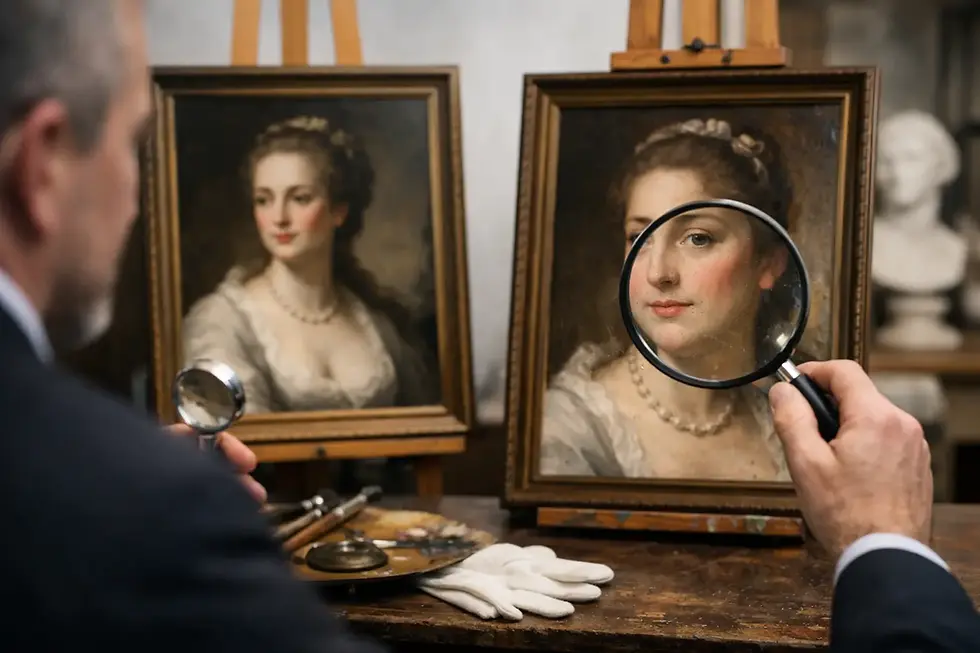
Why an obvious forgery is not a simple category
Collectors often use the term obvious forgery to describe a work with glaring defects. That can include anachronistic pigments, a copied composition with clumsy execution, fabricated labels, or a provenance story that falls apart under basic scrutiny. Those cases exist. Some are indeed crude. But the phrase becomes dangerous when it substitutes for process.
A work can be obviously false in one dimension and still legally, financially, and reputationally complicated. If an attribution has circulated for years, if prior appraisals repeated the claim, or if the object passed through multiple jurisdictions, the issue is no longer whether someone finds it visually persuasive. The issue is whether the conclusion can withstand challenge.
That is why authentication should be treated as a risk-management function, not a matter of taste. Markets do not care how strongly someone feels. They care whether the evidence survives scrutiny from auction specialists, scholars, insurers, litigators, and potential buyers.
The red flags that make forgery seem obvious
Some warning signs are so common that experienced advisors notice them almost immediately. The first is stylistic inconsistency. A work may imitate the surface vocabulary of a known artist while missing structural habits - the cadence of line, the internal geometry of composition, the handling of negative space, the pressure changes in brushwork. Forgers often reproduce appearance but not logic.
The second is material conflict. A painting claimed to be from 1915 cannot contain pigments introduced decades later. A drawing on paper cannot comfortably predate the paper stock, watermark, or treatment visible under examination. A bronze cannot claim a period casting history if the foundry marks, patina behavior, or tooling patterns indicate recent manufacture.
The third is documentary weakness. Provenance that begins with vague family lore, unsupported wartime displacement claims, undocumented private sales, or undated letters should not be dismissed as harmless gaps. In high-value transactions, gaps do not merely reduce comfort. They reduce marketability.
The fourth is opportunistic attribution. If the work appears when demand for a particular artist is rising, if the narrative depends on a newly discovered phase with little scholarly support, or if the signature conveniently transforms an otherwise modest object into a major asset, skepticism is not optional.
These signs can make a work look like an obvious forgery. Sometimes they are enough to walk away. Sometimes they are only the start of a deeper inquiry.
Why visual certainty is not enough
The art market is full of strong opinions delivered with unwarranted confidence. That creates two costly errors. The first is the buyer who accepts a forged work because it feels right. The second is the owner who dismisses a genuine work because someone thought it looked wrong.
Both errors arise from the same weakness - insufficient method. Visual expertise matters. It remains central. But visual review alone cannot establish a defensible conclusion when the stakes are serious. Attribution disputes are rarely resolved by eye alone, especially when a work carries meaningful value or enters a contested transaction.
A disciplined assessment tests several layers at once. Does the provenance hold? Does the object align with known catalog references? Do scientific findings support the claimed date? Does the inscription age correctly? Do labels, stretcher marks, and restorations fit the chronology? Does the comparative analysis reveal invention, imitation, or genuine authorship?
Without that structure, the phrase obvious forgery becomes little more than a market reaction.
How experts evaluate an obvious forgery claim
An obvious forgery claim should be treated like any other serious allegation - by building and testing evidence. The process usually begins with provenance analysis. Not because paperwork is glamorous, but because chronology exposes fraud. Dates fail. Ownership chains break. Export histories conflict. Estate records do not match. One contradiction can change the entire case.
The next layer is stylistic comparison. This is not a casual side-by-side look. It requires comparison against accepted works, known variants, period habits, and workshop practices. Artists evolve. Studios intervene. Copies exist. A competent review distinguishes between deviation, collaboration, later reproduction, and fabrication.
Scientific examination often decides whether suspicion matures into conclusion. Ultraviolet light can reveal restoration patterns, surface interventions, and inconsistencies in varnish behavior. Infrared analysis may expose underdrawing, transfers, or compositional changes that either support authentic creation or suggest mechanical copying. Pigment identification can date materials with precision that stories cannot overcome. Carbon dating, support analysis, microscopy, and high-resolution imaging further narrow the field.
Then comes market-level validation. Catalogue raisonné review, consultation with relevant experts, and comparison against auction and institutional records matter because authenticity is inseparable from liquidity. A work that cannot survive those channels is not merely questionable. It may be commercially disabled.
This is where experienced forensic art advisory work separates itself from informal opinions. A serious conclusion is not a feeling attached to a photograph. It is a documented position supported by converging evidence.
The market consequences of an obvious forgery
When a work is exposed as forgery, the damage is not limited to the object. Capital is impaired. Transaction timing collapses. Insurance assumptions may shift. Estate planning can become contentious. A pending sale may fail quietly or publicly. In some cases, reputational damage exceeds the immediate financial loss.
There is also a subtler problem. Even when a work is not definitively false, insufficient documentation can leave it stranded between belief and proof. In practical terms, that means a ghost asset - owned, insured, perhaps even admired, but difficult to sell on defensible terms. The market discounts uncertainty aggressively.
That is why sophisticated collectors do not ask only whether a work is fake. They ask whether the evidence is strong enough to support future transfer, financing, exhibition, donation, or resale. The difference is decisive.
It depends - and that is exactly the point
Not every suspicious work is a straightforward counterfeit. Some are later copies sold without malicious intent. Some are workshop productions later upgraded by hopeful owners. Some are authentic works burdened by incomplete records, prior restorations, altered signatures, or decades of attribution drift.
That nuance is not an argument for leniency. It is an argument for precision. The wrong label creates its own risk. Declaring an object an obvious forgery without sufficient basis can trigger legal dispute, depress value unnecessarily, or foreclose legitimate scholarship. Declaring it authentic without sufficient basis is worse.
For that reason, serious review is not about dramatic declarations. It is about narrowing uncertainty until a conclusion becomes defensible.
What serious buyers and owners should do next
If a work raises forgery concerns, speed matters, but haste is dangerous. The correct response is controlled verification. Preserve all documents, invoices, shipping records, prior appraisals, conservation notes, and correspondence. Do not attempt cosmetic intervention. Do not rely on seller explanations that cannot be independently substantiated. And do not confuse a certificate, a signature, or a family story with proof.
Before acquisition, insist on evidence proportionate to the value at risk. Before sale, test whether the work can survive independent review rather than assuming prior acceptance will hold. In disputed estates or collections, treat problematic attributions early, before they infect valuation and distribution decisions.
VWART approaches these cases with a simple premise: value is not declared - it is proven. That standard may eliminate works some buyers hope to save, but it also protects capital, credibility, and transaction confidence where those things matter most.
An obvious forgery is only obvious after the evidence is organized, examined, and made to answer hard questions. In this market, that discipline is not caution for its own sake. It is how serious participants avoid turning art into expensive uncertainty.


Comments