
Painting analyzed with UV light,
A painting can look coherent in normal light and still fail under ultraviolet examination. That is why uv light painting analysis remains a standard tool in serious authentication and pre-transaction review. It does not authenticate a work on its own. It does something just as important - it exposes surface evidence that either supports or destabilizes the story attached to the object.
For collectors, estates, and buyers operating at meaningful price levels, that distinction matters. A work is not protected by confidence, reputation, or seller assurances. It is protected by evidence. UV analysis helps establish whether the visible surface is consistent with the claimed age, condition history, and intervention record of the painting.
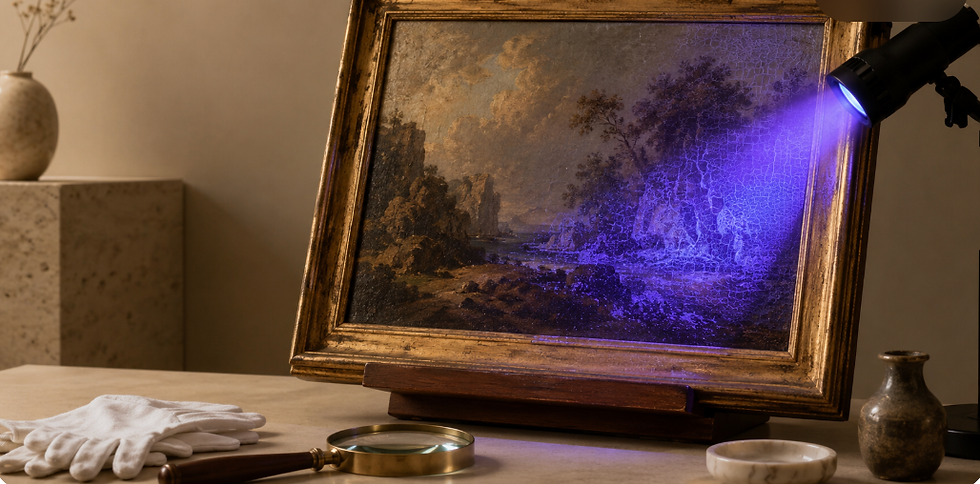
What uv light painting analysis actually shows
Ultraviolet light causes certain materials to fluoresce in distinct ways. Natural resin varnishes, later synthetic coatings, overpaint, retouching, adhesives, accretions, and some restoration compounds can each respond differently. Under UV, the surface begins to disclose a treatment history that standard viewing may conceal.
Older natural varnish often appears with a greenish or yellow-green fluorescence. Areas of restoration may show up as darker zones because many retouching materials absorb UV rather than emit it. Newer varnishes can appear more uniform, cooler, or otherwise inconsistent with the expected age profile of the painting. None of these responses are interpreted in isolation. They are read against the artist, period, support, medium, and known conservation history.
This is where inexperienced interpretation becomes dangerous. A dark patch under UV is not automatically proof of deception. It may reflect documented conservation. By the same logic, an apparently even fluorescence is not automatically reassuring. A painting that has been broadly resurfaced, revarnished, or heavily cleaned may present a superficially coherent UV image while still raising serious authenticity or condition concerns.
Why UV findings matter in the market
In the upper segment of the art market, condition is not a cosmetic issue. It is a liquidity issue. So is restoration history. So is the consistency between what a seller claims and what examination shows.
If a painting is represented as untouched and UV reveals widespread intervention, the problem is immediate. If a work is offered as period-correct and the fluorescence pattern suggests recent additions, the burden of proof shifts. If a painting carries a high attribution but the restoration map obscures key passages, the work may become difficult to place, insure, or resell at the expected level.
This is especially relevant in private transactions, estate dispersals, and cross-border deals where reliance on informal descriptions remains common. One mistake can cost millions. Even when the painting is not a forgery, undisclosed intervention can materially alter value, saleability, and scholarly acceptance.
UV light painting analysis is not authentication by itself
This point deserves precision. UV examination is a diagnostic method, not a final verdict. It is strong at identifying inconsistencies on or near the surface. It is weak when asked to answer questions beyond its scope.
A forged painting can be made to produce a superficially plausible UV response. A genuine painting can show alarming UV anomalies because it was restored aggressively decades ago. A compromised varnish layer can distort the reading. Pigment behavior, prior cleanings, environmental exposure, and photographic conditions also affect interpretation.
That is why defensible authentication does not rest on UV alone. It requires convergence. Provenance, stylistic analysis, high-resolution imaging, infrared review, material study, catalogue raisonné status, and market context all need to align. UV contributes critical evidence, but it remains one layer in a larger forensic structure.
How experts read a UV image
The value of UV analysis lies less in the lamp than in the interpretation. Expert review begins with a baseline question: what should this surface look like if the attribution, age, and condition narrative are accurate?
From there, the examiner assesses varnish uniformity, localized retouching, fluorescence intensity, edge behavior, craquelure interruption, and transitions between original and later material. A restoration confined to a known impact point may be commercially manageable. Broad intervention across signature passages, focal anatomy, or key compositional elements is another matter.
Context controls meaning. A 19th-century painting with modest historical restoration may still perform well in the market if the intervention is stable, old, and transparently disclosed. A supposedly fresh-to-market work with extensive undisclosed inpainting is a different case entirely. The same UV feature can be tolerable in one transaction and disqualifying in another.
Common findings in uv light painting analysis
Certain patterns appear regularly. Retouching often reads as matte, dark, or sharply bounded areas against a fluorescent varnish field. Revarnishing may create an unnaturally uniform surface or conceal earlier treatment boundaries. Adhesive residues and some consolidants can fluoresce in irregular ways, particularly around tears or previous structural repairs.
Signatures deserve special caution. UV may reveal that surrounding paint and varnish behave differently from the inscription area, suggesting later reinforcement or addition. That is not proof of a false signature by itself, but it is a serious trigger for further examination. The same applies to dates, inscriptions, and patches of apparent compositional revision.
Frames and backing materials can also matter. Edge fluorescence may indicate trimming, relining effects, or repaint extending to the margins. These are not minor technical footnotes when attribution or originality is under pressure. They can alter how the object is classified and what the market is willing to accept.
Limits, false comfort, and the need for corroboration
There is a recurring mistake in the market: treating scientific language as certainty. UV is useful because it reveals, not because it resolves everything. It can expose overpaint, but it cannot always determine when that overpaint was applied. It can suggest varnish inconsistency, but it cannot by itself identify every coating material with precision. It can raise doubts about a signature, but it cannot settle authorship without broader evidence.
There is also the opposite mistake - dismissing UV because it is not decisive alone. That misses the point. In high-value art review, risk is rarely identified by a single dramatic discovery. It accumulates through small inconsistencies. UV often provides one of the clearest early warnings that the visible painting is not the whole painting.
For that reason, a disciplined firm will never present UV findings as spectacle. The method belongs inside a controlled process. Evidence is gathered, compared, and tested for coherence. When UV observations match provenance gaps, stylistic deviations, or material anomalies, the case becomes stronger. When they conflict with an otherwise clean narrative, the object requires deeper scrutiny, not optimistic interpretation.
When UV analysis becomes commercially decisive
Not every UV issue destroys value. Some restoration is normal and accepted. Some varnish changes are expected. Some intervention, if well documented and historically appropriate, may have limited commercial impact.
The decisive question is whether the UV findings are consistent with the work as represented and whether they impair market confidence. Auction houses, insurers, lenders, and sophisticated buyers do not evaluate condition in the abstract. They evaluate risk. If the painting cannot withstand scrutiny, it may become a ghost asset - owned, insured, perhaps even admired, but difficult to sell at a defensible level.
This is why UV analysis matters before acquisition, not after disappointment. It matters before consignment, before estate division, before litigation hardens positions, and before a buyer relies on a narrative that the object itself cannot support. In that setting, the role of a specialist such as VWART is not to create reassurance. It is to produce a defensible conclusion based on converging evidence.
What serious buyers should take from a UV report
A credible UV assessment should do more than state that restoration is present or absent. It should explain the character, scale, location, and likely relevance of what is seen. It should distinguish ordinary aging from suspicious intervention. It should clarify whether the observed features are benign, commercially material, or significant enough to challenge the painting's representation.
That level of interpretation changes decision-making. A buyer may proceed, renegotiate, seek further testing, demand revised disclosures, or walk away. Each outcome can be rational. The mistake is acting without a clear evidentiary basis.
The market does not reward hope for long. It rewards proof. UV light can reveal where a painting's surface has been altered, but the larger value lies in what that evidence allows you to decide before the transaction decides for you.


Comments