
Why Certificates of Authenticity do not Protect You, part 3
Authentication Is a Process, Not a Piece of Paper
The public often imagines authentication as a single event.
An expert looks at a painting.
A certificate is issued.
The case is closed.
Serious authentication rarely works this way.
Instead, it involves layers of evidence:
· Provenance research
· Historical analysis
· Stylistic examination
· Comparative study
· Scientific testing
· Materials analysis
· Archival investigation
· Market history
The strongest conclusions emerge when multiple forms of evidence point in the same direction.
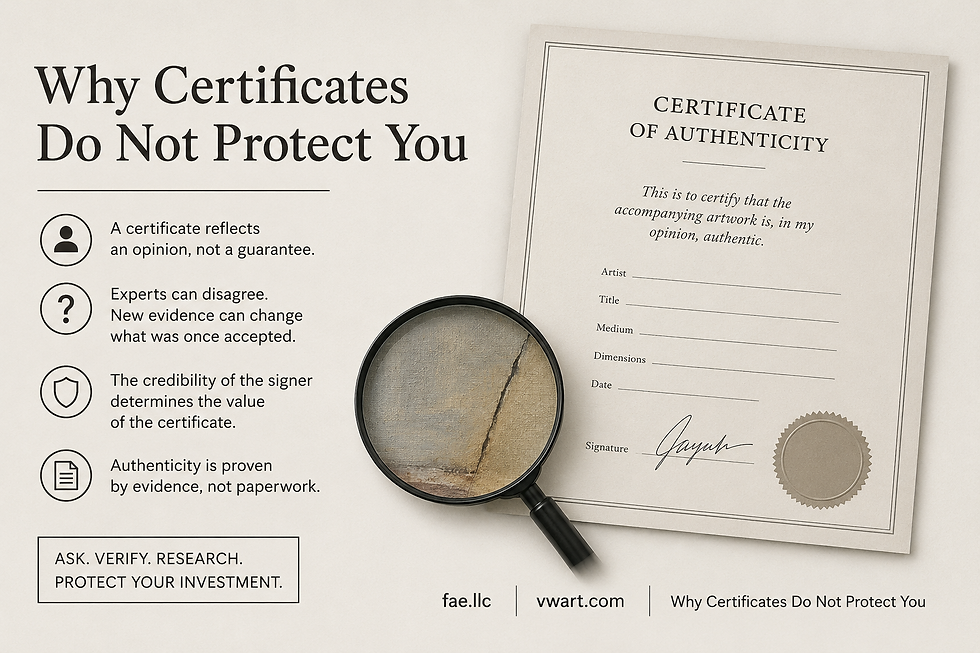
A certificate should be viewed as the conclusion of a process—not the process itself.
Unfortunately, many collectors focus only on the final piece of paper.
What Sophisticated Collectors Understand
The most experienced collectors rarely ask:
“Does it have a certificate?”
Instead, they ask:
“Why was the certificate issued?”
“What evidence supports it?”
“Who recognizes the issuer?”
“What opposing opinions exist?”
“Would this certificate be accepted by the market?”
These are entirely different questions.
And they are far more important.
Sophisticated collectors understand that the market does not reward paperwork.
The market rewards confidence.
Confidence comes from evidence.
Evidence comes from investigation.
A Lesson Worth Remembering
Throughout my career, I have encountered authentic works with weak documentation and questionable works accompanied by impressive documentation.
The paperwork alone never settles the matter.
A certificate can be useful.
It can support a conclusion.
It can summarize research.
It can increase confidence.
But it should never replace independent judgment.
If there is one lesson every collector should remember, it is this:
A certificate does not protect you from making a mistake.
Understanding why the certificate exists is what protects you.
And that understanding begins long before the signature at the bottom of the page.


Comments