
Is the Provenance of My Painting Too Perfect?
When an artwork’s history sounds impressive — but raises more questions than answers
A strong provenance can transform the value of a painting. It can connect the work to an important collection, a historic gallery, a respected auction house, or even directly to the artist. For collectors, provenance is often one of the most reassuring elements in an authentication file.
But there is a problem.
Sometimes a provenance looks too perfect.
It may include famous names, prestigious collections, dramatic family stories, lost archives, old labels, letters, certificates, and a discovery narrative that seems almost designed to convince. At first glance, this can feel exciting. But in the professional art market, an overly perfect provenance can become a warning sign.
A good provenance supports a painting.
A suspicious provenance tries too hard to sell the story.
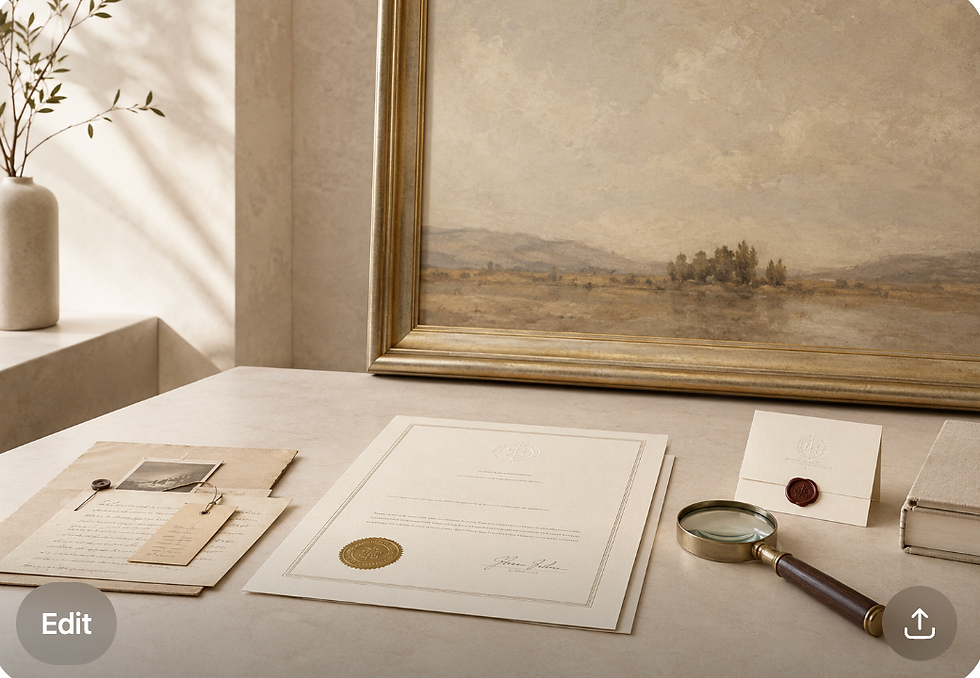
What provenance is supposed to do
Provenance is the documented ownership history of an artwork. Its purpose is not to decorate the painting with prestige. Its purpose is to explain, as accurately as possible, how the artwork moved from the artist to the present owner.
A serious provenance should help answer:
Who owned the painting? When did they own it? How did they acquire it? Where was it kept? Was it exhibited? Was it published? Was it sold publicly? Can the documents be verified? Does the history match the physical object?
The best provenance is not always glamorous. Sometimes it is simple, quiet, and verifiable.
A modest but well-documented history is often stronger than an extraordinary story with no proof.
Why “too perfect” can be dangerous
A suspicious provenance often gives the owner exactly what they want to hear.
It may connect the painting to a famous collector, a major dealer, an old European estate, a private museum, or a direct gift from the artist. It may include a certificate, an old photograph, a family letter, and a story about why the painting remained hidden for decades.
But professional experts do not ask whether the story sounds attractive.
They ask whether the story can be tested.
If every detail seems designed to solve a problem, the provenance may have been built around the attribution rather than discovered through research.
That is a serious concern.
Red flag 1: Famous names with no verifiable link
One of the most common warning signs is the presence of famous names without solid documentation.
For example:
“This painting came from a Rothschild collection.” “It belonged to a friend of Picasso.” “It was owned by a Paris dealer.” “It came from a private Swiss collection.” “It was gifted by the artist.” “It was once in a museum.”
These statements may be true. But without evidence, they are only claims.
A serious provenance must identify the person, the date, the location, and the document that supports the claim.
The more famous the name, the stronger the proof must be.
Red flag 2: The story fills every gap too conveniently
Real provenance often has gaps. That is normal, especially with older works.
But a suspicious provenance often has an answer for everything.
There is a reason why the painting was never published. A reason why it was never shown publicly. A reason why no invoice exists. A reason why the artist did not sign it normally. A reason why the family never contacted the recognized expert. A reason why the work stayed hidden. A reason why all previous documentation disappeared.
Individually, some explanations may be possible. Together, they may become a pattern.
When every problem has a convenient explanation, the story needs to be examined very carefully.
Red flag 3: Old labels that do not prove enough
Old labels can be useful. They may reveal a gallery, collection, inventory number, exhibition, or transport history.
But labels are not proof by themselves.
A label can be transferred from another painting. A frame can be changed. A backing board can be replaced. A label can be added later. A label may refer to a different work.
A label may be real, but unrelated to the attribution.
The key question is not whether the label looks old.
The real question is whether the label connects specifically and verifiably to this exact painting.
Dimensions, title, medium, subject, artist name, and collection history must match.
Red flag 4: Certificates from the wrong authority
A certificate of authenticity can look impressive, especially when it is old, stamped, signed, or written in formal language.
But a certificate is only as strong as the authority behind it.
Important questions include:
Who issued the certificate? Was that person recognized for this artist? Did they inspect the painting in person? Did they have access to archives? Is the certificate still accepted by the market? Has the artist’s catalogue raisonné changed since then? Would a major auction house rely on this certificate today?
Many paintings have certificates that are commercially useless.
A certificate may support a case, but it does not automatically make a painting sellable.
Red flag 5: The provenance is more impressive than the painting
This is one of the most important points.
Sometimes the history sounds extraordinary, but the painting itself does not have the quality, technique, structure, or visual intelligence expected from the artist.
In such cases, the provenance may be compensating for weakness in the artwork.
A serious expert always starts with the object.
Does the painting itself support the attribution? Does the quality make sense? Does the technique match the artist? Does the work fit the claimed period? Does the composition feel natural or forced?
If the painting is weak, even a beautiful provenance may not save it.
The artwork must carry the story.
The story should not carry the artwork.
Red flag 6: The documents are too clean, too complete, or too dramatic
Authentic archives are often messy. They contain inconsistencies, old handwriting, partial information, faded ink, missing pieces, uncertain dates, and practical details.
Suspicious documents sometimes feel theatrical.
They may repeat the artist’s name too often. They may describe the painting too perfectly. They may include unnecessary explanations. They may use language that feels modern. They may appear designed for future authentication rather than normal historical use.
Professional document review looks at more than content. It examines paper, ink, language, format, terminology, signatures, dates, and whether the document makes sense within its supposed historical context.
A document should feel like it belonged to its time.
Red flag 7: The provenance begins exactly where the problem begins
A weak provenance often begins after the period that matters most.
For example, a painting attributed to an artist from 1905 may only have documentation beginning in 1980. That may still be useful, but it does not prove what happened between the artist and the first documented owner.
The critical question is:
Can the painting be connected to the artist’s lifetime, studio, dealer, early collector, exhibition, or archive?
A provenance that starts too late may help ownership history, but it may not solve authentication.
Red flag 8: The story depends entirely on family memory
Family history can be valuable. Many important artworks have passed privately through families for generations.
But memory is not documentation.
A family may sincerely believe a painting was by a famous artist because that is what they were told. Over time, a story can become stronger, more detailed, and more certain, even without evidence.
The role of an expert is not to insult family memory.
The role of an expert is to separate memory from proof.
A family story can be a starting point. It should not be the final evidence.
Red flag 9: The painting was previously rejected or avoided
If the work has already been shown to a major auction house, foundation, committee, or catalogue raisonné authority, that history matters.
A previous rejection does not always mean the painting is false. Sometimes a work is rejected because the evidence was incomplete, the photographs were poor, or the wrong strategy was used.
But it must be disclosed.
Trying to hide previous negative opinions can destroy credibility.
In the art market, undisclosed rejection is one of the most damaging provenance issues.
Red flag 10: The provenance cannot be independently verified
The strongest provenance can be checked.
A gallery can be contacted. An archive can be searched. An auction catalogue can be found. A collection inventory can be compared. A photograph can be dated. A label can be matched. A letter can be authenticated. A catalogue raisonné entry can be reviewed.
If every important part of the provenance depends on private claims, unavailable documents, unnamed owners, or unverifiable statements, the risk increases.
Privacy is normal in the art market.
Total unverifiability is not.
What a serious expert does with a “too perfect” provenance
A professional review does not accept or reject a provenance emotionally. It tests it.
The process usually includes:
Document reviewOwnership chain analysis Archive research Comparison with known records Gallery and auction history checks Catalogue raisonné research Condition and label examination Photographic analysisSignature and handwriting review Market acceptance assessment
The goal is not to destroy the story.
The goal is to discover which parts can be trusted.
The difference between provenance and marketability
A painting may have some genuine historical documents and still remain difficult to sell.
Why?
Because the market may require a higher level of proof.
For major artists, auction houses, insurers, collectors, and museums may want:
Catalogue raisonné inclusion Recognition by a foundation or committee Accepted expert opinion Clean ownership history No unresolved title issues No previous rejection Strong technical consistency Reliable market documentation
Provenance helps. But marketability requires acceptance.
This is why a painting can have a beautiful story and still be commercially fragile.
Questions to ask before trusting a provenance
Before relying on a painting’s history, ask:
Can each owner be identified?
Can dates be verified?
Do documents describe this exact work?
Are dimensions and titles consistent?
Are there unexplained gaps?
Do labels match the painting?
Are certificates from recognized authorities?
Has the work been rejected before?
Does the quality of the painting support the story?
Would the market accept this evidence?
These questions are not negative. They are protective.
They can save a collector from expensive mistakes.
Final thought
A perfect provenance should not be accepted simply because it sounds impressive.
In art authentication, the most convincing stories are often the ones that deserve the most careful examination.
A serious provenance does not need drama. It needs consistency, verification, and market relevance.
The real question is not whether the story is beautiful.
The real question is whether the evidence can survive scrutiny.
A provenance can make a painting stronger.
But when the story sounds too perfect, it may need deeper examination.
Famous names, old labels, certificates, and family stories are not enough unless they can be verified.
In art authentication, the question is not whether the story is beautiful.
The question is whether the evidence survives scrutiny.


Comments